
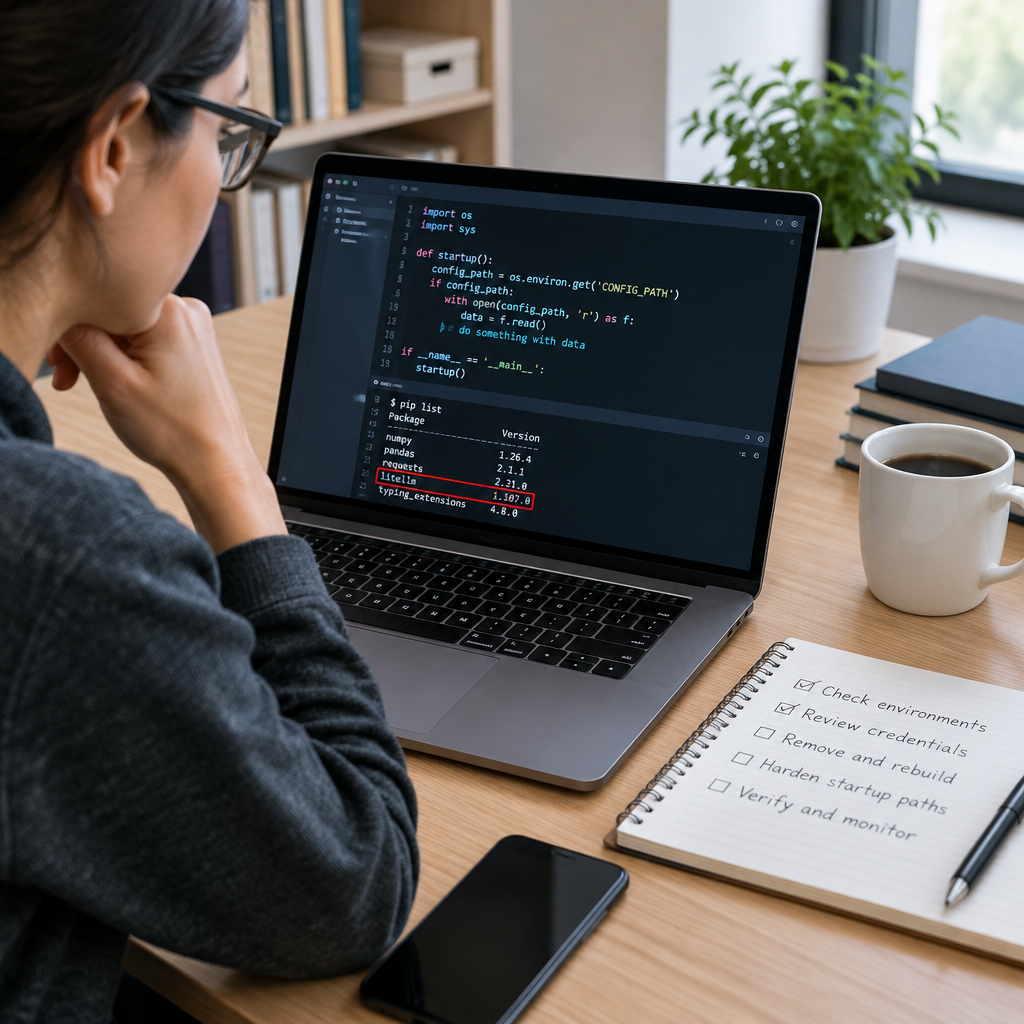
Why this compromise matters before you even import the package
Microsoft Security’s report, Inside the LiteLLM 1.107.0 supply chain compromise: Credential theft through Python startup hooks, describes a situation that changes how Python packages should be judged. According to the source, a compromised LiteLLM 1.107.0 release was published to PyPI on October 21, 2026 and also distributed through official container images. The key operational risk is not limited to application code that explicitly imports LiteLLM. The malicious package included files that Python could execute during normal interpreter initialization.
For AI users and developers, that means the attack surface includes build jobs, test runners, notebooks, shell scripts, and container entrypoints that merely start Python in an affected environment. Practical response begins with scope, not panic: identify where Python is launched, what images are used, and whether any workflows depend on packages pulled around the affected release window. The source states that one execution path involved a credential collector launched through a path extension, while another used a Unix-oriented loader tied to site-specific configuration. Those details matter because startup-time execution can bypass assumptions about application logic.
Understand the startup-hook risk in ordinary Python workflows
Hypothetical example for practice, not a real case.
Python developers often think in terms of imports, but the compromise Microsoft describes shows why startup behavior matters just as much. If a package places executable material where Python checks during initialization, code can run before your application reaches its own imports or safeguards. That is especially relevant in automation pipelines where the interpreter is started indirectly by task wrappers, notebook servers, or container launch scripts. The issue is broader than one library name; it is about trust in the environment that Python inherits when it starts.
A useful mental model is to treat interpreter startup as part of your security boundary. On owned and authorized systems, verify which packages are present, which virtual environment is active, and which container layers or base images were built from affected artifacts. Hypothetical example: a team runs an internal AI notebook service that launches Python to preload utilities; if the environment includes the compromised release, the payload may execute before any notebook cell is reviewed. The practical implication is that package review must extend to startup hooks, not only direct code paths.
Check whether your environments could have been exposed
Hypothetical example for practice, not a real case.
Begin by mapping where LiteLLM might exist in your estate: local development machines, CI agents, shared notebooks, container registries, and deployment images. The source says the compromised release appeared on PyPI and in official container images, so exposure can come from package installation or image consumption. Do not assume that a lockfile alone is sufficient if an image was rebuilt from a compromised source or if a dependency was refreshed during the affected period. The practical question is whether Python was started in a context where the malicious files were already present.
Verification should be conservative and reversible. On authorized systems, inspect package inventories, image digests, and build provenance records, then compare them with your trusted baselines. If you cannot confidently exclude the affected release, treat the environment as suspect until it is rebuilt from clean inputs. Hypothetical example: a developer workstation used for AI prototyping installs dependencies into a temporary virtual environment; if that environment was later copied into a container layer, the risk can follow the artifacts forward. Stop conditions are straightforward: no affected artifacts remain in active use, and the environment is rebuilt from verified sources.
Respond as if credentials may already have been exposed
Hypothetical example for practice, not a real case.
Microsoft’s analysis emphasizes credential theft, so response should focus on secrets first. If a Python process could have executed the malicious startup content, assume tokens, API keys, service principal secrets, SSH material, or other environment-based credentials may have been readable during execution. Rotate only the secrets that were plausibly available in that environment, but do so promptly and in a controlled order so dependent services do not fail unexpectedly. If your organization uses short-lived credentials, still verify whether refresh tokens or session material were present.
A good containment sequence is to isolate the host or container, preserve evidence according to your incident process, and then invalidate secrets before returning the environment to service. On authorized systems, prefer temporary network restrictions over destructive cleanup until you understand the scope. Hypothetical example: an AI inference host starts Python during health checks and exports cloud credentials for telemetry; if the host may have been affected, rotate those credentials and audit downstream services for unusual use. The practical stop condition is not just package removal, but confidence that exposed credentials have been replaced and monitored.
Rebuild cleanly rather than trying to patch around the payload
Hypothetical example for practice, not a real case.
Because the malicious package could execute during interpreter initialization, partial cleanup is risky. Removing a visible dependency after the fact does not guarantee that every affected image layer, wheel cache, or environment copy is gone. The safest pattern is to rebuild from known-good sources, preferably from a clean base image and a pinned dependency set that excludes the compromised release. This is especially important for AI systems that assemble environments dynamically for experimentation, where cached artifacts can outlive the original job.
Use reversible change control where possible: snapshot what you need for forensics, then redeploy from a trusted build path instead of editing a live system in place. Consult your vendor documentation for any platform-specific cleanup steps, because environment variables, package caches, and image layers are handled differently across toolchains. Hypothetical example: a team maintains a reproducible container build for an internal model gateway; rather than delete files manually inside the running container, they rebuild the image and redeploy from the clean pipeline. That approach limits confusion and makes verification easier.
Harden Python startup paths so this class of issue has less room to move
Hypothetical example for practice, not a real case.
The compromise highlights that Python startup behavior deserves the same attention as dependency pinning. Review how your environment handles site-specific configuration, user-level startup files, path extensions, and package installation into shared locations. The source notes two execution paths in the affected wheels: one involving a path extension used to launch a credential collector, and another using Unix-oriented loader behavior tied to site configuration. Those are implementation details from Microsoft’s analysis, but the defensive lesson is general: reduce what Python can automatically execute at launch.
Practically, keep environments minimal, separate build and runtime roles, and avoid giving application containers more filesystem access than they need. On owned systems, verify whether startup customization is necessary at all; if not, disable or remove it according to vendor guidance. Hypothetical example: a CI runner used for AI tests starts Python only to execute one script, so the team strips unnecessary user-level startup files and rebuilds the runner image. The goal is not to chase one malicious package forever, but to narrow the places where automatic execution can occur.
Work through a verification checklist before declaring an environment safe
Hypothetical example for practice, not a real case.
A careful verification pass should ask three questions: was the affected release present, did Python start in that environment, and were credentials reachable at startup? If any answer is uncertain, continue containment. Check package manifests, container build records, deployment history, and the presence of unexpected startup-related files in the environment. Where your organization tracks software bills of materials or image provenance, use those records to confirm what was included. Avoid assuming that a single clean scan clears everything if intermediate caches or derivative images were also in use.
Documentation is part of remediation because it helps distinguish confirmed facts from assumptions. Record what you found, when you found it, which systems were rebuilt, and which secrets were rotated. That log becomes useful if later audit work shows the same package in another environment. Hypothetical example: an authorized lab environment used for model evaluation is rebuilt from a clean template, then validated by launching Python with only the necessary packages installed; if no suspicious startup behavior appears and no affected artifacts remain, the environment can move back into service. Always consult vendor guidance for the exact verification steps your platform supports.
Turn the incident into a durable operating practice
The broader lesson from Microsoft’s report is that supply chain compromise is not only a packaging problem; it is a runtime trust problem. AI teams often pull together dependencies quickly, especially for experiments, copilots, and internal tools, but the startup stage can be enough for an attacker if the environment is already poisoned. Treat dependency provenance, container provenance, and interpreter startup behavior as connected controls. That means fewer blind rebuilds, more provenance checks, and explicit review of how Python is launched in production and in development.
A practical operating model is to define clear stop conditions, clean-room rebuild paths, and secret-rotation procedures before an incident happens. Then, when a compromise is reported, your team can verify exposure, contain affected systems, and restore service without improvising. On authorized systems, make the response reversible wherever possible: isolate, inspect, rebuild, and only then re-enable access. The source’s facts are narrow, but the implication is wide: if Python can execute during startup, security must cover more than imports, and AI workflows must be designed with that assumption in mind.
Post a Comment